
Oríkì
Breath, Vibration, and Lineage in Yoruba Thought
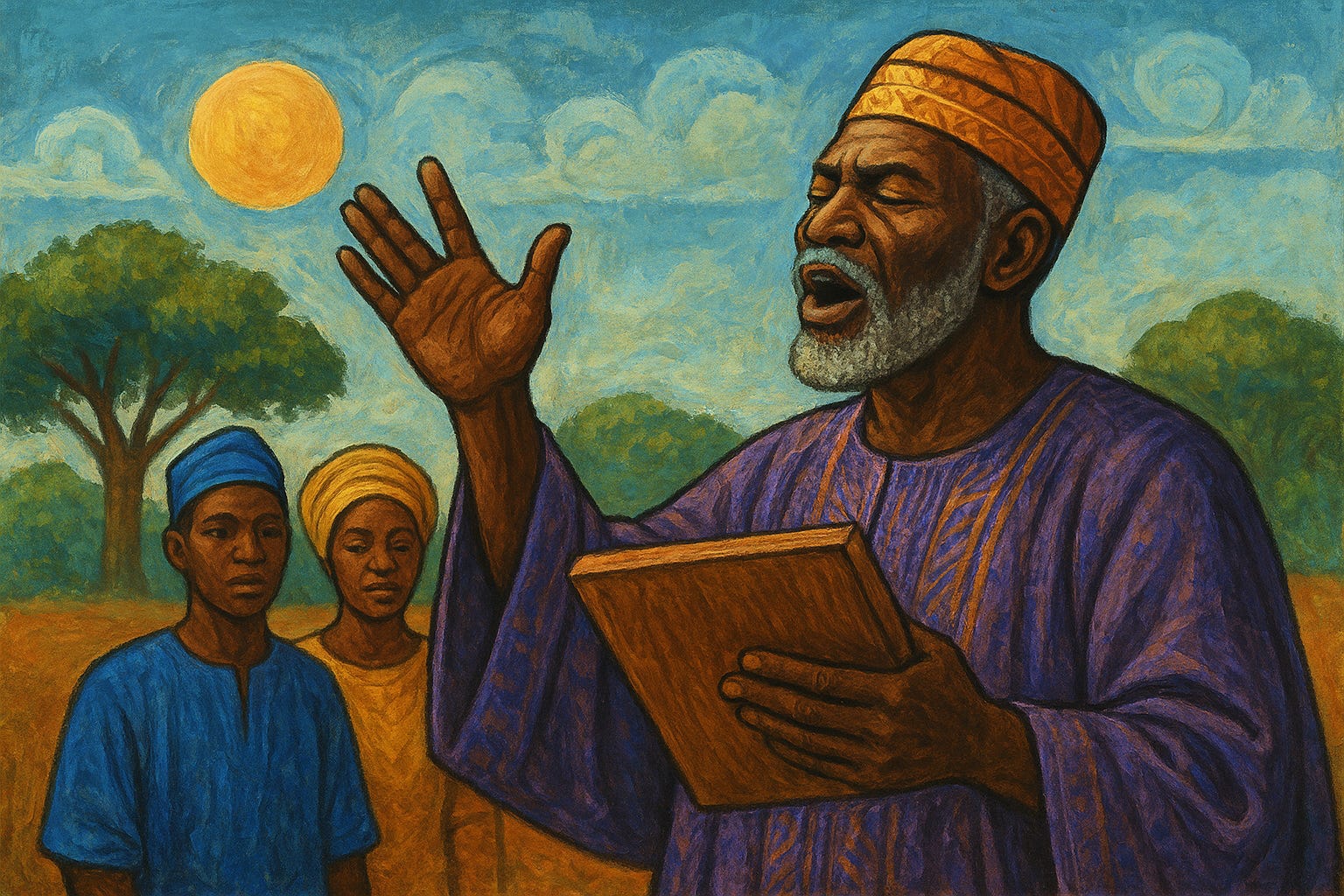
In the Yoruba imagination, Oríkì (panygerics) are often mistaken by outsiders as mere praise names, decorative words strung together to flatter. But Oríkì are far more profound: they are archives, living databases of lineage and memory. They do not simply describe; they invoke, they awaken, they encode identity.
Every Oríkì begins with the same breath: A. This is not accidental. It is cosmological. In the Yoruba phonetic universe, the letter “A” is the first sound, the most open vowel, the primal utterance that rides on breath (ẹ̀mí). To begin with “A” is to align speech with life itself; this is power of Àṣẹ (primal force of life as we know it). To declare Àṣẹ as the Yoruba do after every decree is to assign a stamp of divine authority. Àṣẹ literally means “Let is be so”.
Fun fact: The word “Amen” that adherents of Abrahamic faith (Christians and Moslems especially) utter after every prayer is actually an invocation of the Kemetic (Egyptian) deity called “Amun Ra”.
Why does this matter? Because in Yoruba thought, creation is speech. Olódùmarè spoke the world into being, and nothing exists outside the vibration of Ọ̀rọ̀ (the Word). The power that makes words effective is called Àṣẹ. It is no coincidence that Àṣẹ itself begins with the letter A. Thus, when an elder chants Oríkì, the opening “A” is not a letter — it is the very key that unlocks the ancestral archive, that summons the energy of origin.
This is why Oríkì do not only recount the past but recreate it. They make the unconscious conscious. They re-present destiny in the now. When you hear:
Àkànjí ọmọ Àgan (Àkànjí, son of Àgan)
Àjàyí ọmọ Àjàní (Àjàyí, son of Àjàcní)
Àmọ̀sọ̀ ọmọ Àlàbí (Àmọ̀sọ̀, son of Àlàbí)
Àdébáyọ̀ ọmọ Àdéríbigbé (Àdébáyọ̀, son of Àdéríbigbé)
These are not mere words; they are cosmogenic pronouncements. They re-establish who you are, where you come from, and the power that surrounds you.
Oríkì, therefore, are not just praise. They are invocation. They are mnemonic codes tying each lineage back to its source. They are affirmations of unity-in-diversity: different families, professions, and towns, but one breath, one “A”, one Àṣẹ. To speak Oríkì is to participate in the very act of creation. To bear Oríkì is to carry a living archive of your existence. And to begin with “A” is to remember that every destiny is spoken into being by the primal breath of life.
Names are not merely assigned diminutives — they are channels. Earth itself is a vibrating universe, and Yoruba is a particularly vibrating, tonal language. Every name, every Oríkì, is a frequency, a tuning fork aligning the bearer with cosmic rhythm. This is why elders insist: Orúkọ ń rò ni — a name shapes destiny.
The oppressors knew this. They understood that to sever a people from their tongue was to strip them of their vibration, their codes, their spiritual channels. That is why generations of our forbears were forbidden from speaking their own language. This was no accident. The so-called “vernacularisation” of Yoruba and other indigenous languages was a deliberate act of disarmament, reducing a sacred frequency to something dismissed as common.
Yet Yoruba endures. To speak it, to chant Oríkì, to name our children in it, is to restore vibration. It is to re-member what was scattered. It is to call back Àṣẹ into the present moment. Every “A” at the start of an Oríkì is a reminder that our universe still hums, still vibrates, and that we are not broken. To remember your Oríkì is to step back into resonance with creation itself.
Ire o 🌴
This was yet another beautiful read. I hold onto this:
"Every “A” at the start of an Oríkì is a reminder that our universe still hums, still vibrates, and that we are not broken." — stunning!
One fun fact: 'amen'/'ameen' is a Semitic word with deep roots in Hebrew and Aramaic, and only has similarity to “Amun”, but not linguistic roots.