
Òjúkòkòrò
How Greed Displaced the World
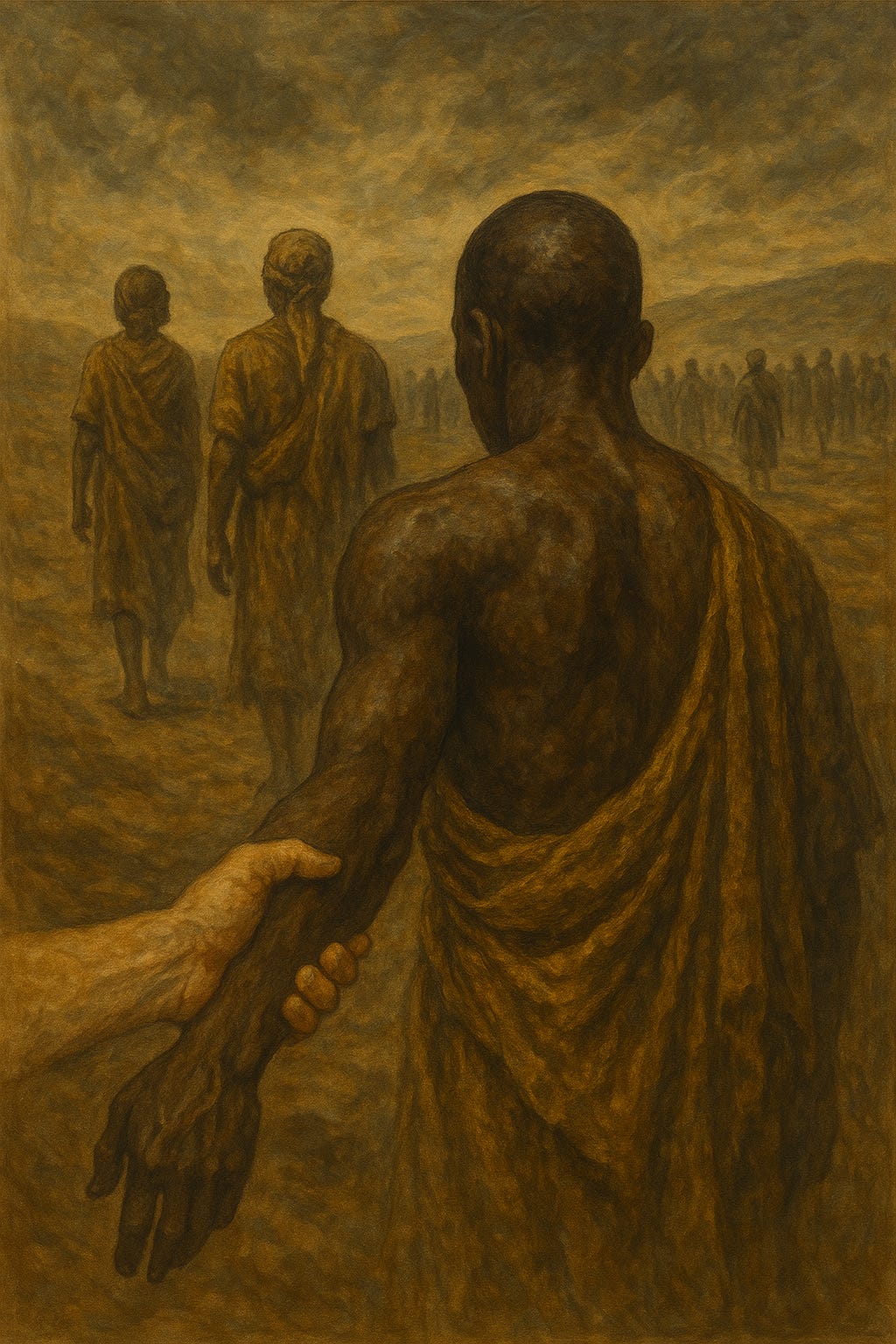
Whenever a handshake extends beyond the elbow, you are no longer in a polite exchange. You are in a full-scale gidigbo aka wrestling.
There is a rhythm in Yoruba that carries memory.
A rhythm that begins with Òjúkòkòrò, the greedy eye, the covetous gaze, and flows into Ìsọ̀fọ̀, a dissolving, a loss, the sorrow of being undone and unrooted.
These are not just words.
They are philosophical instruments, tuned to the frequencies of justice, history, and grief.
Òjúkòkòrò birthed Ìsọ̀fọ̀.
It always begins quietly.
A stranger arrives.
He marvels at the abundance - the soil that yields, the people who sing, the gods who speak in rain and river.
He smiles. Learns a few greetings. Tastes the yam.
Then something shifts.
Admiration sharpens into desire.
Desire calcifies into entitlement.
Entitlement demands a story.
So the land becomes “empty.”
The gods become “false.”
The people become “lost.”
And the visitor, now armed with language and steel, steps into the center and declares it his.
Because, as the elders say,
Whenever a handshake extends beyond the elbow, you are no longer in a polite exchange. You are in a full-scale gidigbo.
The gesture of peace becomes the grip of conquest.
The dance becomes a duel.
Beneath the cloak of civility lies the calculated reach of domination.
That is how Ìsọ̀fọ̀ unfolds.
Not only through war or treaties, but through narrative violence.
Through a gaze that cannot behold beauty without wanting to possess it.
A gaze that sees sacredness and whispers, this should be mine.
From South Africa to Ilọrin, from Australia to Palestine, history groans under the weight of Òjúkòkòrò - covetous eyes that saw thriving peoples as too rich, too sacred, too brown to be left alone.
The result? Ìsọ̀fọ̀, a dissolution so violent, entire lineages were reduced to echoes and footnotes.
Yoruba thought doesn’t shy away from naming this. There is no wisdom in living in denial.
We are not strangers to betrayal.
Our proverbs carry the memory of wounds.
Our tongue knows how to hold pain without forgetting its music.
We have seen kings dethroned by cousins.
Towns renamed by strangers.
Divinities silenced in their own spaces.
And yet, we still remember.
Ilọrin remains one of the clearest illustrations.
A Yoruba city by origin, reshaped by a mix of internal compromise and external dominance.
Political betrayal cloaked as divine order.
The people of the land reduced to tenants on ancestral soil.
What happened in Ilọrin is not unlike what happened in Cape Town, Quebec, or Gaza.
Different costumes. Same drama.
What links them all is the sickness of Òjúkòkòrò,
the unwillingness to coexist with difference,
the urge to dominate what one does not understand.
And when Òjúkòkòrò sits on the throne,
Ìsọ̀fọ̀ follows like thunder after lightning.
But there is another rhythm.
A countercurrent.
To remember is to resist erasure.
To tell these stories is to uproot the lie that the world belongs only to those who can take.
Yoruba thought teaches us that land is not property but inheritance.
Not to be hoarded, but honoured.
That which you seize by greed will never truly belong to you.
Even if you rename it.
Even if you build churches or pipelines or high-speed trains on it.
There is a proverb:
"Ẹni tí kò mọ ibi tí ó ti ń bọ, kì yó mọ ibi tí ó ń lọ."
“He who forgets where he is coming from will not know where he is going”
The world today suffers from that forgetting.
It forgets the sacredness of the first peoples.
It forgets the violence of covetous conquest.
It forgets that those who were displaced still carry memory in their bones.
But memory is a quiet drum.
It does not die.
What if we listened?
What if we saw Òjúkòkòrò for what it is — a spiritual corruption, not just a political strategy?
What if we recognized Ìsọ̀fọ̀ not just as historical fact, but as an ongoing condition?
What if restoration is not just about returning land, but restoring the rhythm of justice?
In Yoruba thought, everything has a rightful place.
When things are removed from their place, even the sky feels it.
Realignment is not optional.
It is cosmic necessity.
May those who have been undone find their grounding again.
May those who dissolved what was not theirs come to repentance.
May the stories return to the people who lived them.
And may we all learn to behold beauty without needing to own it.
See, not everything we see is ours to take.
Losses are indeed a part of reality in this plane of existence which we all must not shy from. In a sense, we shouldn't hold on to anything too much. Afterall, life itself is fleeting. Self-preservation is not evil.
To those who say that the earth belongs to no one, perhaps they are right but it is fair to affirm that beneath the collectivist stance is deep seated naivety. Nothing is ever always what they seem.
Regardless, may we all come to learn how to truly BE whatever that even means. Àṣẹ
Ìrẹ o 🌴