
Èrò
The Foundation of Yoruba Thought and the Journey from Unconsciousness to Consciousness
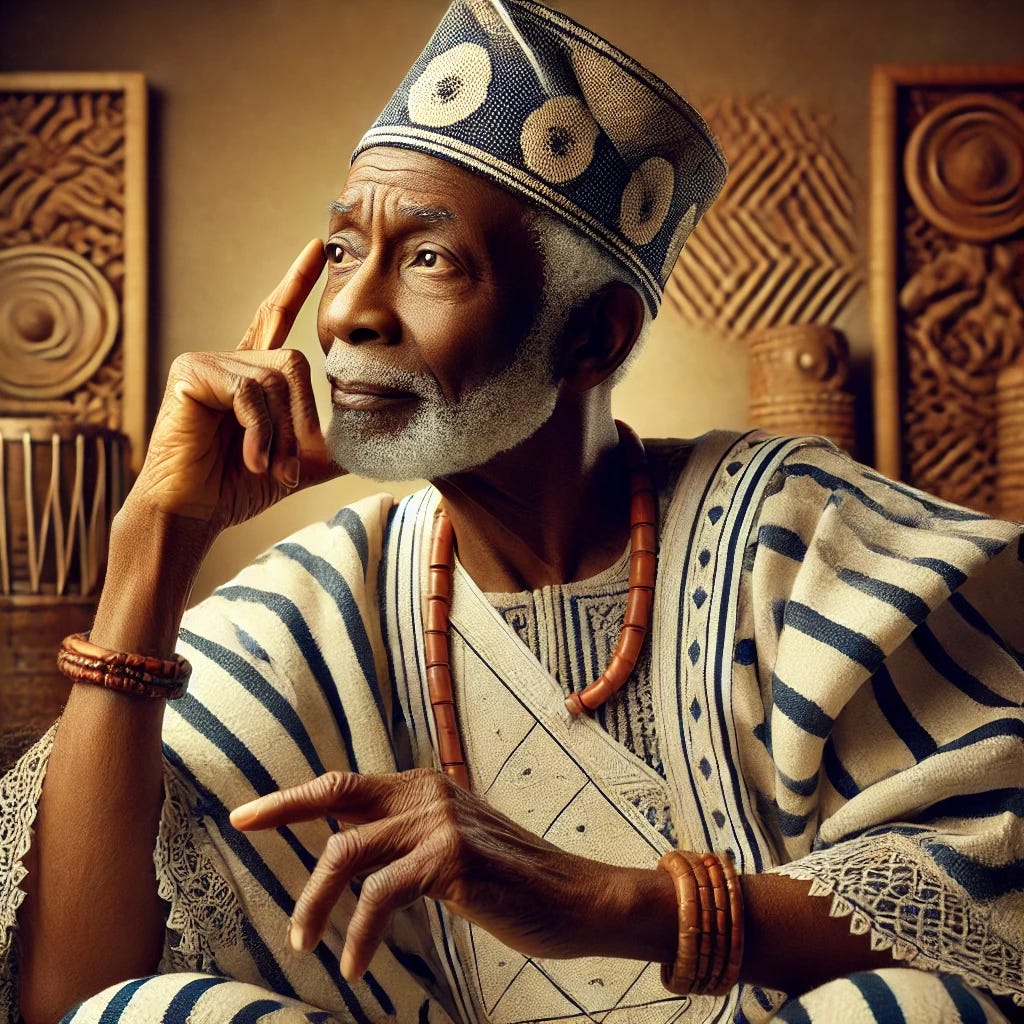
Alágbára má mó èrò, bàbá òlẹ
Powerful one who does not engage in thought is the father of laziness.
The Yorùbá have always placed immense value on the art of thinking. Our elders of old would often say, "Alágbára má mó èrò, bàbá òlẹ," lamenting those who fail to engage in the labor of deep reasoning. It is a clarion call to action for anyone who seeks true strength: physical prowess without critical thought is, at its core, mere laziness.
But what do we mean by Èrò? This word, rich in meaning, encapsulates more than just mental activity. It speaks to the profound process of mixing and sorting, where thoughts, like ingredients in a pot - are stirred and refined. Just as one must sift through the chaff to find the grain, Èrò requires a careful, conscious engagement with the mind’s contents. The Yorùbá understand that no person, no community, can rise above their level of thought. To think is to live, to grow, to transcend.
In many ways, this pot of thought mirrors ancient principles like the Egyptian Thoth, god of wisdom, writing, and the hidden mysteries of the mind. The act of sorting through our thoughts can be likened to a spiritual process, bringing light into dark places, unearthing truths buried deep in the subconscious. Indeed, much of what happens in our minds is beyond our immediate awareness. Carl Jung once said, “Until you make the unconscious conscious, it will direct your life and you will call it fate.” The Yorùbá have long known this - life, to a large extent, is about making the unseen seen, the unknown known.
Picture a pot of stew on the fire, being stirred.
This is the essential image that comes to mind when we try to understand the word Èrò (thought). While the È in Èrò is a prefix, the noun in Èrò (È + rò) is rò, which is that which is being stirred. The verb state for Èrò is “Ìrònú” which is the actual act of thinking; the process of stirring.
In this sense, Yorùbá thought is principally inductive rather than deductive - thought is an active, ongoing process of mixing, testing, and refining. However, this does not mean that deduction is absent from the Yorùbá approach; rather, the word Èrò (as in Ìrònú) speaks directly to the method of reflection by which our elders sift through and integrate thoughts. In understanding this etymology, we gain insight into how Yorùbá thinking embodies both grounded observation and the blending of ideas to reveal deeper truths.
When we think of Èrò in this way, we realize that thought is not just about what we actively ponder but also what we allow to emerge from beneath the surface. It is the skill of discerning, of listening to the whispers of intuition, of recognizing patterns that are not immediately obvious. The proverb "Àgbọ́yé ti jẹ́ kí àrà ò ń dẹ́nu," meaning "Understanding prevents confusion," reminds us that in clarity of thought lies the power to navigate life’s complexities.
In embracing Èrò, we must also acknowledge that not every thought deserves action, nor every idea immediate expression. As the Yorùbá aphorism goes, "Eèró kì í jọkòó ti kì í san," meaning "A hurried thought does not yield good results." True wisdom is patient; it waits for the right moment to bring forth the ripe fruit of deep reflection.
This brings us to a key insight: thought is not a passive exercise. It is an active sorting, a weighing and balancing of ideas, emotions, and impulses. To engage Èrò is to undertake the noble task of aligning our internal world with the external, to make the unconscious conscious, and to forge paths where there once was none.
Call to Action: Embrace the Work of Thought
As we journey through life, let us remember the profound wisdom of our forebears. Thought is the birthplace of all action, the wellspring of all transformation. Let us, like the thinkers of old, carry our calabash of Èrò with care, sifting and sorting with patience and diligence. As we move forward, may we strive to bring more of what lies hidden within us into the light of consciousness. Only then can we truly become the masters of our fate, the authors of our own destiny.
To my fellow travelers in this journey of thought, I encourage you to pause and reflect on the contents of your own calabash. What are you mixing? What needs sorting? Where can you bring more awareness to the thoughts that shape your life? The journey to becoming truly awake begins with this - acknowledging that the power of Èrò lies in our willingness to engage deeply, patiently, and with purpose.
Join me as we explore the vast landscapes of Yoruba thought, where ancient wisdom meets modern consciousness. This is just the beginning.
Àṣẹ (It is so)
Upcoming: In the next installment, we shall explore the Yorùbá sacred concept of Orí (metaphysical head) as it relates to Èrò (thought) and Òrò (words). Orí is to be considered as “Àpò Ìrònú”; the pouch or sack where thinking is facilitated; the home of thoughts.